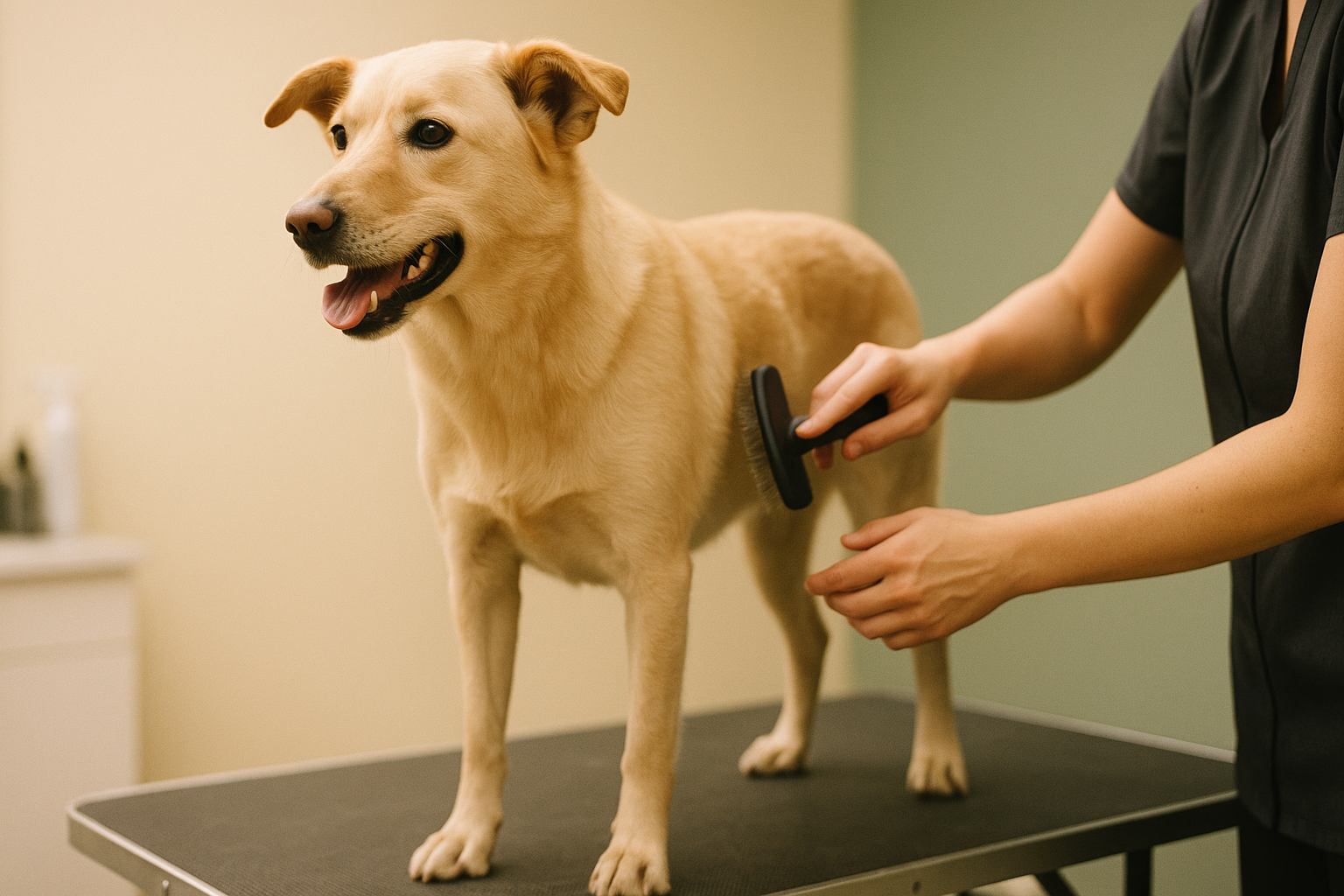
"Low-stress grooming." It's on a lot of salon websites. It shows up in Instagram bios and Google listings. It's become the phrase that owners of anxious dogs search for, and so it's the phrase that salons have learned to use.
The problem is that it means almost nothing by itself. A salon can describe itself as low-stress and still see fifteen dogs a day, keep animals in cages between steps, and run sessions back-to-back with no pause. None of that is illegal. Some of it is quite normal in the industry. But it's not what most people picture when they read "low-stress."
This isn't about accusing anyone. It's about giving you the questions to ask before you book — so the phrase does some actual work.
What the phrase usually signals
When a salon genuinely means it, "low-stress" tends to involve a few specific things: working at the animal's pace rather than a fixed schedule, limiting the number of animals in the space at any given time, avoiding unnecessary confinement between grooming steps, and having at least one person per animal for the duration of the session.
It might also include familiarity with calming signals in dogs — the lip licks, yawning, looking away, weight shifting that indicate stress before it becomes visible distress — and a willingness to stop a session or slow down when those signals appear.
None of this is exotic or requires specialist certification. It mostly comes down to volume and pace.
The single most reliable indicator of a low-stress environment is how many animals the salon sees per day — and whether they'll tell you directly when you ask.
The questions worth asking
Before you book anywhere, these are the questions that will tell you more than any website description:
How many animals do you see per day? A salon that sees twenty dogs a day is running to a schedule. One that sees four or five has more room to slow down when needed. There's no perfect number, but anything over eight or ten per groomer per day should prompt follow-up questions.
Is my dog in a crate or kennel between grooming steps? Some salons bathe multiple dogs, then dry them in rotation, then cut them in sequence. This means significant cage time for each animal. Others work with one animal at a time, start to finish. For anxious dogs, this difference matters.
What do you do if my dog becomes distressed mid-session? A groomer confident in their approach will have a direct answer: we slow down, we take a break, we call you. Vague reassurance that "it'll be fine" is a different kind of answer.
Will my dog be with the same person for the whole session? Handoffs between groomers add unfamiliarity. For a nervous dog, staying with one person they've had a chance to settle with makes a real difference.
What it doesn't mean
Low-stress grooming is not a guarantee that your dog will enjoy the experience. Some dogs don't enjoy grooming regardless of how carefully it's handled. Anxiety doesn't disappear after one calm session — it improves gradually, over repeated calm sessions.
It also doesn't mean the groomer will never use restraint of any kind. Holding a dog steady while working around their face, for example, is necessary. The difference is between brief, purposeful handling and sustained forced restraint while the dog is panicking.
And it doesn't mean a session will take twice as long. Working at a calm pace is not the same as working slowly. An experienced groomer who isn't rushing through back-to-back appointments can often complete a session in the same time as a rushed one — just without the adrenaline on both sides.
How to read what a salon actually does
A few practical things to look for beyond the questions above: do they ask about your dog's history before the first session? Do they have a phone number rather than just an online booking form? Does the person you speak to seem to want to understand your specific dog, or are they just confirming a slot?
If a salon books you in without asking anything about your dog — not their breed, not their experience with grooming, not whether they've been anxious before — that's information about how the session will go.
At Groom and Fluff, we take two or three animals per day, by appointment only. When you contact us, we ask about your dog before we confirm anything. That's not a special service — it's just how we think the process should work.